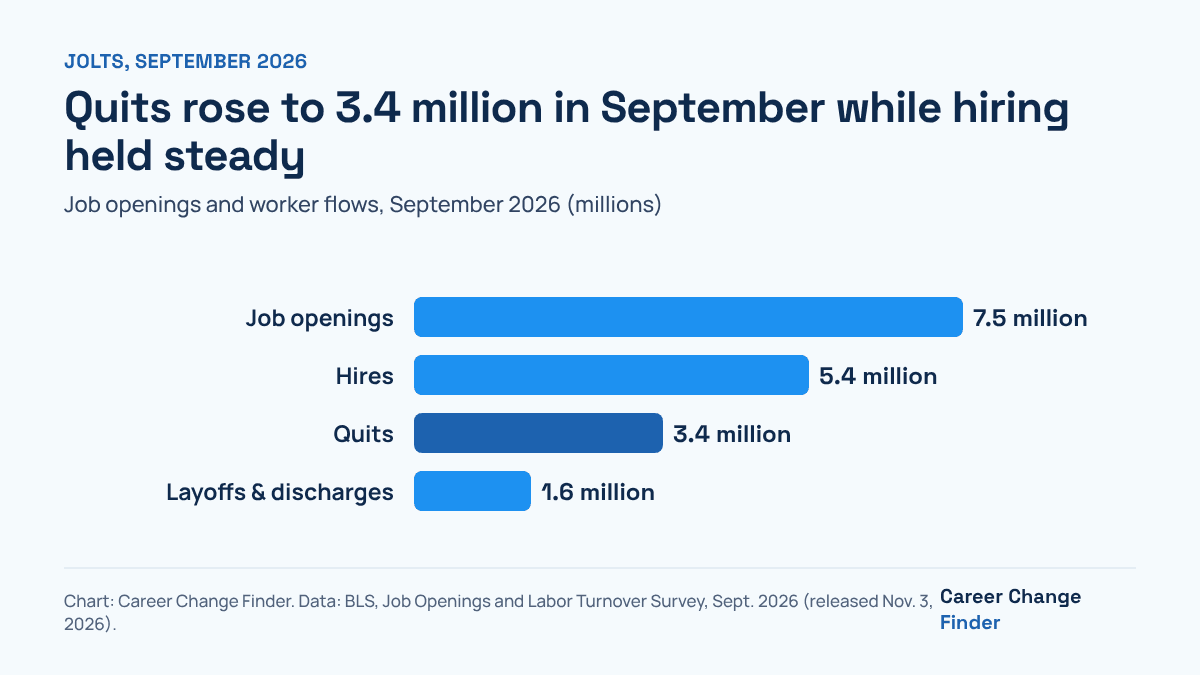
More Americans quit their jobs in September 2026, even as the number of job openings and hires barely changed, according to the Job Openings and Labor Turnover Survey (JOLTS) released by the Bureau of Labor Statistics on November 3.
Quits increased to 3.4 million, a rate of 2.1% of all workers. Job openings were little changed at 7.5 million (a rate of 4.5%), hires held at 5.4 million (3.4%), and layoffs and discharges stayed at 1.6 million (1.0%). Total separations, which add quits, layoffs and other exits, were 5.3 million.
Why the quits number matters
Economists watch quits closely because many people who quit do so to take another job. A rising quit count usually means workers feel confident they can find something better, and job switchers tend to get larger raises than people who stay put.
For anyone thinking about a career change, the September numbers send a mixed signal:
- Openings are still plentiful. The 7.5 million openings are slightly more than the 7.1 million people counted as unemployed in the October jobs report, which gives switchers room to look.
- Hiring is slow. Hires of 5.4 million a month mean employers are filling roles carefully. Expect longer searches and more weight on proof that your skills fit.
- Layoffs remain low. At 1.0% of workers, layoffs are not pushing people out in large numbers, so most moves right now are by choice.
Switching without starting over
Quitting is easier when the next job uses what you already know. In our research on better-paying careers within reach, 88.5% of the 732 careers we studied had at least one close skill match that pays at least 10% more and usually needs no extra schooling. The typical pay gap to the closest such match was 24.4%.
A few practical steps before you quit:
- Find your closest matches. Type your current job into our Career Change Tool to see careers with similar skills, their pay and the training they need.
- Check the gap honestly. Each match shows the skills you would still need to learn. Our guide on how to change careers with no experience covers ways to close it.
- Talk to people in the job. Informational interviews are the fastest way to learn whether a role fits before you leave your current one.
What comes next
The BLS will publish JOLTS data for October 2026 on December 1. With the October jobs report showing 165,000 new payroll jobs (see our coverage), the next release will show whether the rise in quits continued.
Sources: U.S. Bureau of Labor Statistics, Job Openings and Labor Turnover Survey, September 2026 (released November 3, 2026); Career Change Finder, Better-Paying Careers Within Reach.