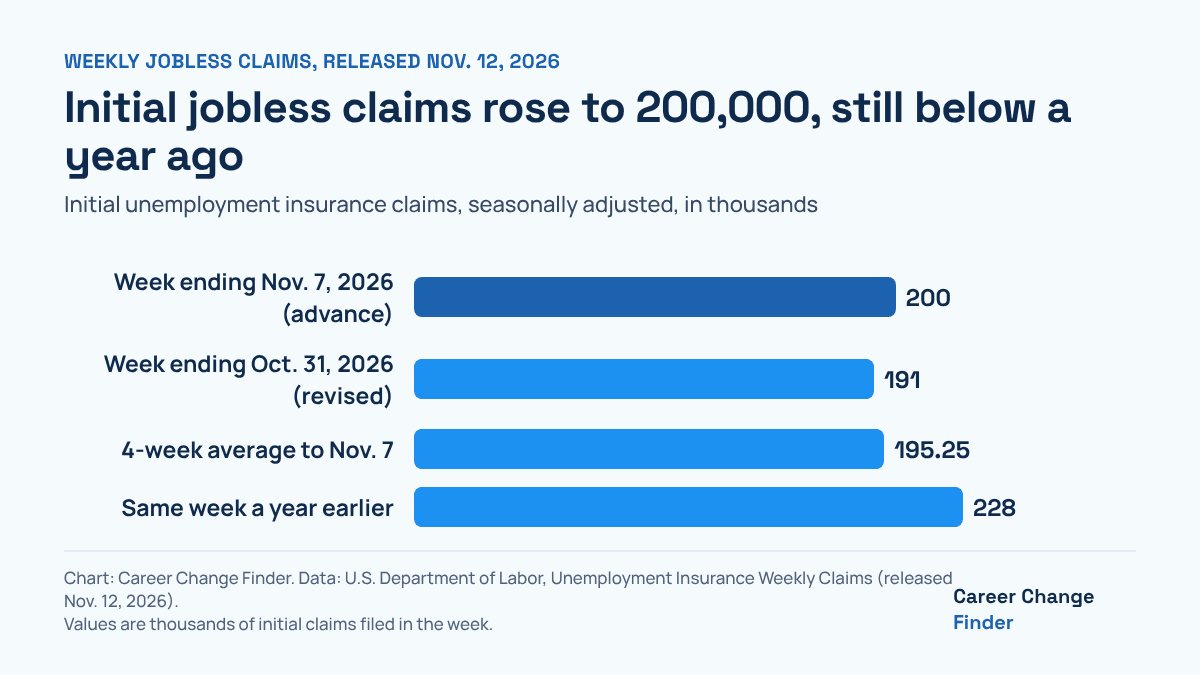
New claims for unemployment benefits rose to 200,000 in the week ending November 7, 2026, an increase of 9,000 from the week before, the U.S. Department of Labor reported on Thursday, November 12. Even after the rise, initial claims were well below the seasonally adjusted 228,000 in the same week a year earlier. Initial claims count people filing for benefits for the first time, so they are one of the quickest signs of how many workers are being laid off.
The department also revised the previous week up by 2,000, from 189,000 to 191,000. The 4-week moving average, which smooths out week-to-week swings, was 195,250, unchanged from the week before.
The headline numbers
| Measure (seasonally adjusted) | Latest | Week before | A year earlier |
|---|---|---|---|
| Initial claims, week ending Nov. 7 | 200,000 | 191,000 | 228,000 |
| Initial claims, 4-week average | 195,250 | 195,250 | 227,000 |
| Insured unemployment, week ending Oct. 31 | 1,697,000 | 1,717,000 | 1,946,000 |
| Insured unemployment rate | 1.1% | 1.1% | 1.3% |
Source: U.S. Department of Labor, Unemployment Insurance Weekly Claims, released November 12, 2026.
Insured unemployment, the number of people still receiving regular state benefits, fell by 20,000 to 1,697,000 in the week ending October 31. That is 249,000 fewer than the 1,946,000 a year earlier. Before seasonal adjustment, 206,982 initial claims were filed in the week ending November 7, up 28,870 from the week before. The seasonal factors had expected a rise of 19,663, which is why the adjusted figure went up.
Among states, the largest increases in initial claims (not seasonally adjusted) in the week ending October 31 were in Illinois (+728), Indiana (+655) and Washington (+647). The largest decreases were in New York (−1,524) and Texas (−1,481). The department said New York's drop reflected fewer layoffs in accommodation and food services, transportation and warehousing, and health care and social assistance.
What it means if you are changing careers
Weekly claims are a measure of layoffs, not of hiring. A low and steady level means most employers are keeping the people they have. For someone planning a career change, that matters in two ways: fewer layoffs usually means more time to plan a move while still employed, and it also means fewer experienced workers competing for the same openings after losing a job.
The three industries named in New York's figures all hire into careers that people often move into from other fields. According to BLS pay data from May 2025:
- In health care, licensed practical and licensed vocational nurses earn a median of $64,400 and medical assistants $45,690, often after programs of a year or less. Registered nurses earn $97,550.
- In transportation and warehousing, logisticians earn a median of $82,320 and dispatchers $50,340.
- In accommodation and food services, people who start on the floor can move into food service managers at $69,390 or lodging managers at $69,250.
These are national medians. Pay for the same job can differ a lot by state, as our research on how much the same job pays in each state shows. To see which of these careers fit the skills you already have, try the Career Change Tool, and read how to change careers without a pay cut before you make a move. For the bigger picture on hiring, see our coverage of the October jobs report.
What comes next
This week's claims report was released at 8:30 a.m. Eastern time on Thursday, November 12. On the BLS schedule, the next major release for career changers is State Employment and Unemployment for October 2026, due on Friday, November 20.
Sources: U.S. Department of Labor, Unemployment Insurance Weekly Claims, week ending November 7, 2026 (released November 12, 2026); U.S. Bureau of Labor Statistics, Schedule of Selected Releases, November 2026; BLS Occupational Employment and Wage Statistics, May 2025, via our career pages.