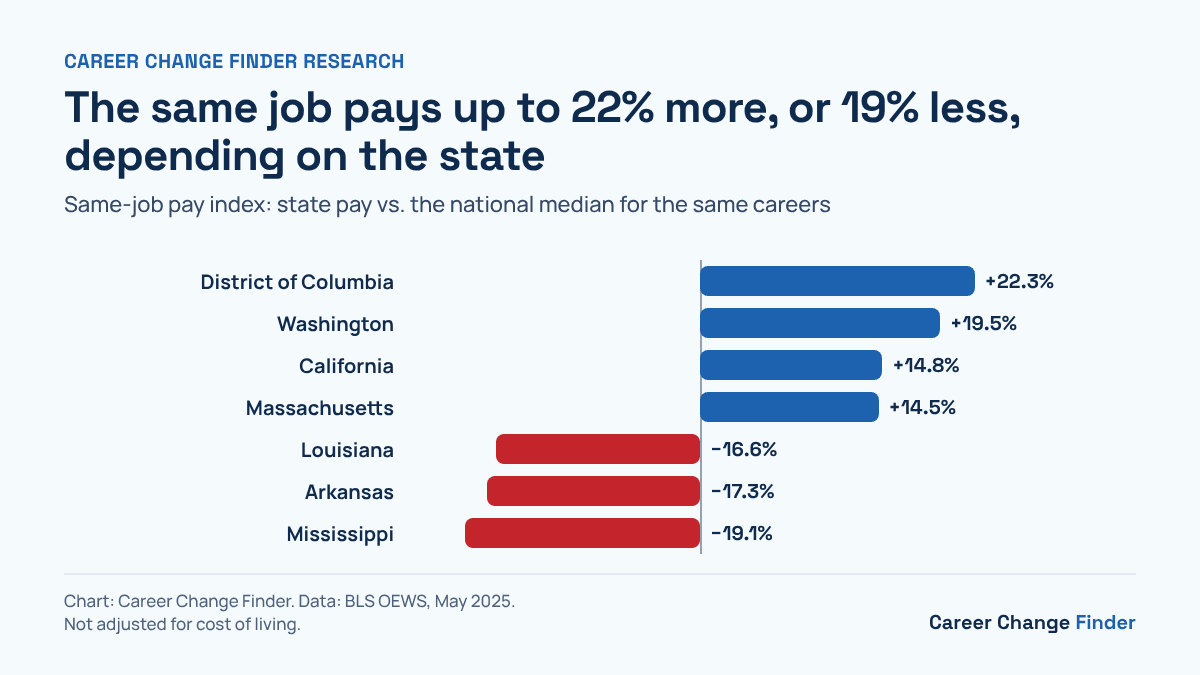
Where you work can matter almost as much as what you do. A new Career Change Finder study of federal pay data finds that, for the typical U.S. career, the best-paying state pays 83% more than the lowest-paying state for the same job.
The analysis, published today, compares state median pay for 454 careers with reliable figures in at least 30 states, covering about 135 million workers, using the Bureau of Labor Statistics' Occupational Employment and Wage Statistics for May 2025.
Key findings
- In 167 careers (36.8%), the top state pays at least double what the bottom state pays. Those careers employ about 35 million people.
- In 409 of the 454 careers (90.1%), the gap between the highest- and lowest-paying state is at least 50%.
- Comparing each job only with itself, the same work pays 22.3% above the national median in the District of Columbia and 19.5% above it in Washington, but 19.1% below it in Mississippi.
- The District of Columbia (83 careers), Washington (72) and California (63) are the top-paying place for the most careers.
Big jobs, big gaps
The gaps show up in some of the country's largest occupations. Registered nurses earn a median of $140,270 in California and $77,080 in Alabama, a gap of 82%. General and operations managers earn $173,690 in New Jersey and $74,050 in Arkansas. Fast food and counter workers earn $42,280 in California and $22,610 in Mississippi.
The widest gaps appear in tipped work, such as waiters and waitresses, and in jobs whose pay is set by state or local budgets, such as judges. The narrowest are in jobs with national pay scales: postal service mail carriers' pay varies by only 12% from the top state to the bottom.
Read the gap with care
The figures are not adjusted for cost of living. Prices in 2024 ran from 10.7% above the national average in California to 13.1% below it in Arkansas, according to the Bureau of Economic Analysis, so part of the pay gap is offset by lower prices. Experience, employer and city also matter as much as the state.
For someone weighing a career change, moving is not the only way to use these gaps. Remote roles, employers that pay national rates, and careers with narrower state gaps can all change the math.
Methodology and data
The study uses careers with their own national BLS median pay. A state figure counts only when BLS estimates at least 100 jobs with a relative standard error of 25% or less. The same-job pay index for each state is the employment-weighted median of state-to-national pay ratios across every career with a reliable figure in that state. The full method, the state ranking and two CSV files are on the study page: Same Job, Different Pay.
Sources: Career Change Finder, Same Job, Different Pay: How Your State Changes Your Salary (November 11, 2026); U.S. Bureau of Labor Statistics, Occupational Employment and Wage Statistics, May 2025; U.S. Bureau of Economic Analysis, Regional Price Parities by State, 2024.