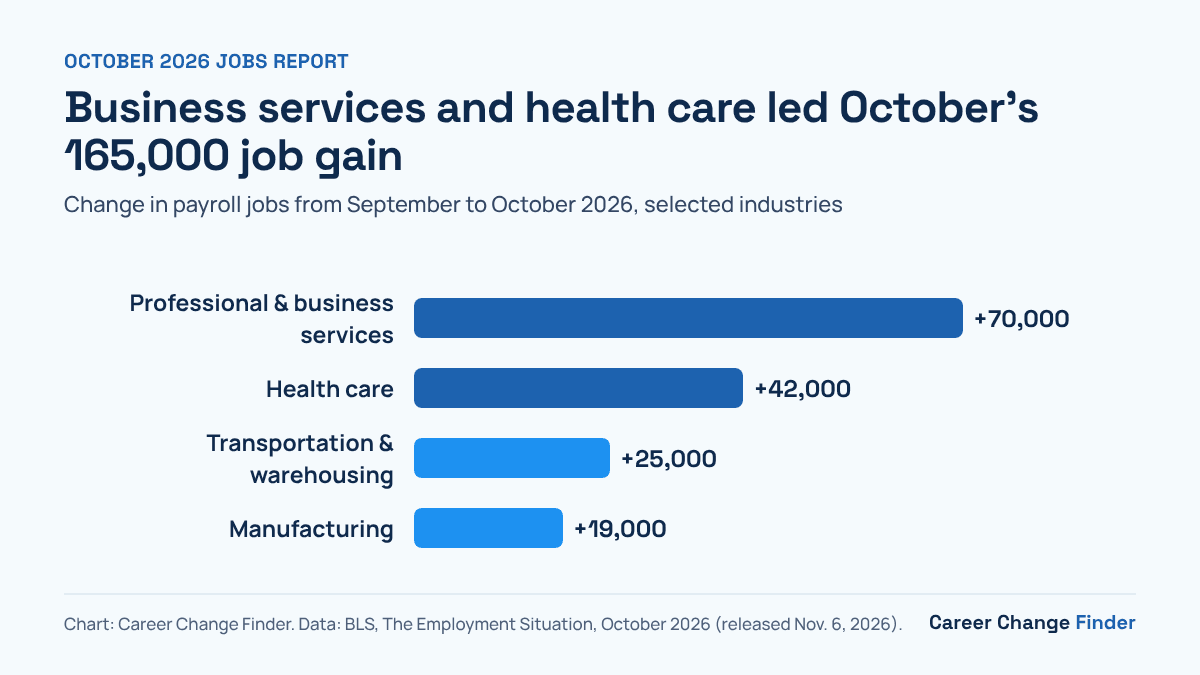
U.S. employers added 165,000 jobs in October 2026, and the unemployment rate held at 4.1%, the Bureau of Labor Statistics reported on Friday, November 6. The gains were concentrated in a few industries: professional and business services added 70,000 jobs, health care 42,000, transportation and warehousing 25,000 and manufacturing 19,000. Most other major industries, including construction, retail, leisure and hospitality and government, changed little.
The report also raised its estimates for the two previous months. August is now put at +186,000 jobs (up 53,000 from the earlier estimate) and September at +60,000 (up 31,000).
The headline numbers
| Measure | October 2026 |
|---|---|
| Payroll jobs added | 165,000 |
| Unemployment rate | 4.1% |
| People unemployed | 7.1 million |
| Unemployed 27 weeks or more | 2.0 million (27.6% of the unemployed) |
| Labor force participation rate | 61.9% |
| Average hourly earnings, private workers | $38.00 (+0.4% on the month, +3.1% on the year) |
Source: BLS, The Employment Situation, October 2026.
What the gains mean if you are changing careers
A monthly jobs report does not tell you which job to pick. It does show where employers are adding people right now, and three of the four growing industries hire into careers that many people move into from other fields.
Health care keeps adding jobs month after month, and not all of them need years of school. According to BLS pay data from May 2025:
- Registered nurses earn a median of $97,550 and number about 3.4 million, the largest group in the field. Most enter with an associate or bachelor's degree in nursing.
- Respiratory therapists earn $82,280 and surgical technologists $64,650, usually after an associate degree or certificate program.
- Medical assistants earn $45,690 and phlebotomists $45,230, with programs that can take less than a year.
Professional and business services is a broad group that covers accounting, consulting, tech and administrative work. Careers in it include project management specialists at a median of $102,320, management analysts at $101,860 and accountants and auditors at $83,680. Many people move into project management from operations, teaching or the military, where they already planned work and led teams.
Transportation and warehousing includes heavy truck drivers, with a median of $58,640 and about 2.1 million jobs, and logisticians at $82,320. Warehouse and driving jobs often lead to dispatch, logistics and transportation and distribution management roles, where the median is $107,230.
Pay growth
Average hourly earnings for private-sector workers reached $38.00 in October, up 14 cents on the month and 3.1% over the year. That is the average across all private jobs, so it hides large differences between careers and places. Our research on how much the same job pays in each state found that for the typical career, the best-paying state pays 83% more than the lowest-paying one.
What to do with this
If one of these fields interests you, start from the job you have now. Our Career Change Tool shows which careers use the skills you already have, with real pay and the training each move usually needs. If you want a move that pays more without a long detour, read how to change careers without a pay cut.
The next jobs report, for November 2026, is scheduled for release by the BLS in early December.
Sources: U.S. Bureau of Labor Statistics, The Employment Situation, October 2026 (released November 6, 2026); BLS Occupational Employment and Wage Statistics, May 2025, via our career pages.